Europe: Russia, Ukraine & NATO
Potential pathway: escalation from conventional conflict into direct Russia–NATO confrontation. Monitor crisis communication, force posture and diplomatic developments.
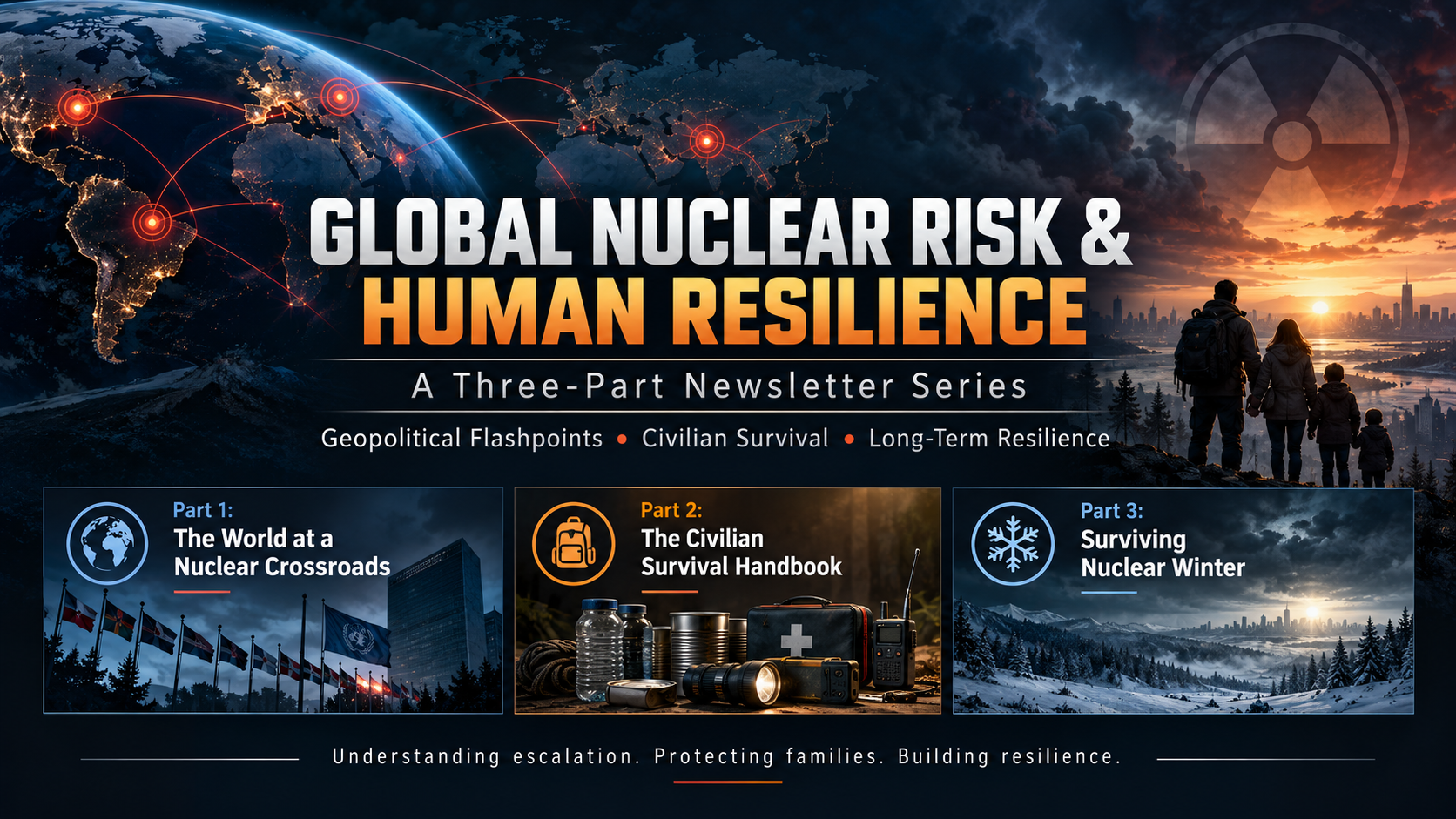
A three-part resource on geopolitical escalation, protecting civilians during radioactive fallout, and safeguarding food, drinking water, energy and communities against prolonged disruption.
Evidence-led analysis, not a prediction of warNuclear-armed states assessed by SIPRI, January 2026
Estimated global warheads, January 2026
Estimated deployed warheads, January 2026
Source: SIPRI Yearbook 2026 press release. Nuclear weapon inventories indicate capability, not a verified probability of use.
These five clusters illustrate potential escalation pathways involving nuclear-armed states or sensitive facilities. They are not ranked predictions. Distinguish conventional fighting, nuclear weapons use and radiological accidents.
Potential pathway: escalation from conventional conflict into direct Russia–NATO confrontation. Monitor crisis communication, force posture and diplomatic developments.
Distinct bilateral security relationships involving nuclear-armed states. Watch border incidents, military mobilization and safeguards against miscalculation.
Potential maritime or air confrontation with impacts on shipping, semiconductor supply chains and regional security.
North Korea, South Korea, Japan and the United States face risks associated with deterrence, missile activity and conventional escalation.
Potential military escalation and facility-related radiological incidents. Iran is not among SIPRI's nine nuclear-armed states.
Reliable crisis hotlines, deconfliction, arms-control verification, diplomacy and robust command systems can reduce the danger of unintended escalation.
Related Mathnal research: Volatility, risk and probability · Fuel, fertilizer and forex resilience.
CDC indicates staying indoors for at least 24 hours may provide protection, subject to emergency instructions and local conditions. Removing outer clothing can eliminate up to 90% of deposited radioactive material. CDC guidance.
Respirators and suits do not block penetrating gamma radiation; consumer meters cannot certify food or water safety.
Water safety: Boiling does not remove radioactive material. Stored sealed supplies and official laboratory testing are essential; never assume home filters remove all radionuclides. CDC food and water guidance.
Extreme nuclear-war scenarios could alter temperature, sunlight and rainfall, reducing crop and fishery production. A peer-reviewed Nature Food study modeled potential famine-related deaths exceeding five billion in one large US–Russia scenario; this is a conditional model, not a forecast.
Rotate sealed dry staples, pulses and canned food. Secure clean, dry, pest-resistant storage. Avoid potentially contaminated exposed produce until authorities confirm safety.
Protected hydroponics, mushrooms, sprouts and greenhouses can supplement diets, but need clean inputs and often electricity. They cannot easily replace staple calories.
Protect water storage, filtration capacity, medically essential power, communication redundancy and equitable neighbourhood distribution.
⬇ Download editable Excel food & water planner (1–36 months)
Plan staple food and essential provisions for 1 to 36 months. Set the number of people, household daily consumption, and region-specific staple foods. Every figure is adjustable and calculated in dry/raw food weight where applicable. The planner is built directly into this newsletter and can export your personalized shopping list.
For consistency, each planning month is treated as 30 days. A 36-month plan therefore uses 1,080 planning days; actual calendar dates may vary. Food quantities are raw/unprepared weights. Vegetables, fruits and some protein foods are perishable and require preservation and storage planning.
| Food / provision | Example | Per person per day | Family total over period | Storage guidance |
|---|
Illustrative consumption-based quantities, not a nutritionally complete meal plan or validated multi-year stockpile. Check calorie and nutrient adequacy, individual medical needs, expiry dates, temperature and storage capacity; account separately for food preparation water and fuel. Never consume food potentially exposed to fallout until authorities confirm safety.
Related Mathnal insights: Agri-Intelligence and Food stock and inventory planning.
Related research and applications: Agri-Intelligence · Inventory optimization · Supply Chain Community.
Publication year, estimated global inventory, stockpiles, deployed weapons and alert range. Includes source and reference date.
Download CSV Download ExcelWater-volume scenarios for household sizes 1–8 and 3-, 7-, 14- and 30-day periods.
Download CSV Download ExcelSafety supplies and preparation items with priorities and usage notes, suitable for printing or importing into Excel.
Download CSV Download ExcelRegional grain and pulse reference sheet, plus storage assumptions and suggested complements.
Download CSV Download ExcelEnter the nearest appropriate building, shelter in a basement or central interior space, stay inside and listen to official alerts. Source: CDC.
CDC advises that staying inside for at least 24 hours can provide protection; follow local emergency officials and leave if remaining is life-threatening.
Boiling does not remove radioactive materials. Treatment suitability varies by radionuclide and must be verified by appropriate tests.
No. Consumer radiation meters cannot reliably certify food or water for radionuclide contamination; laboratory testing is required.
A hypothetical large-scale climate disruption caused by atmospheric soot from major fires after nuclear conflict, potentially affecting sunlight, temperatures and agriculture.
No universally safe location can be established. Assess water, agriculture, healthcare, energy, shelter, safety and legal feasibility; do not evacuate into fallout without official instructions.
Updated 19 October 2026. This publication separates verified historical or inventory facts, illustrative conflict scenarios and modeled humanitarian outcomes. It is not a real-time emergency alert system or a forecast of war.
Explore more: Mathnal Insights newsletter archive · Supply chain data infrastructure · ML and AI supply chain resilience.